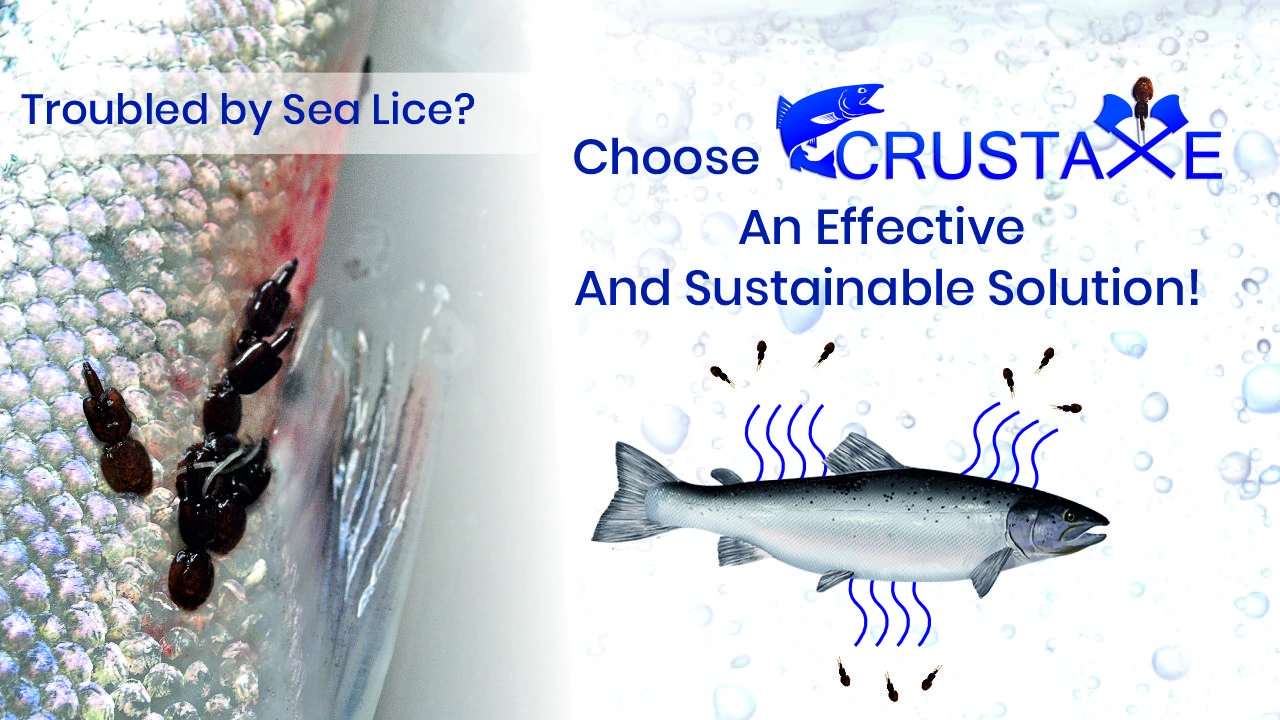
Salmon are among the most successful aquaculture species, and the production has grown drastically over the decade. This has been possible due to the ability of innovative aquaculture technologies to increase product diversity and trade while lowering production costs. However, these high-density food production environments are particularly susceptible to the spread of pests and diseases that are likely to generate economic damages. Parasitic sea lice infestation is one of the most important factors affecting salmon-producing countries.
WHAT IS A SEA LICE?
Sea Lice are a group of invertebrate crustacean copepods, of the family Caligidae, found world-wide. Out of many species, the two most highly parasitic species are:
Caligus rogercresseyi, which infests over eighty different species of marine fish,
Lepeophtheirus salmonis (the salmon louse), which primarily infests salmon species.
HOW IT ATTACHES TO THE FISH?
At the intermediate copepod stage, sea lice use their hooked antennas and frontal filaments to latch onto the fish. While they feed on their host, they remain too small to cause significant harm. However, as they mature into more mobile pre-adult and adult stages, sea lice shift their attachment method to suction, making them more lethal. They mostly feed on host mucus, skin, and underlying tissue.
IMPACT OF SEA LICE INFESTATION ON FISH-
Primary host responses include reduced appetite and growth. The increased stress, external wounds, and reduced vitality due to lice infection are also likely to increase host susceptibility to secondary infections of viral or bacterial disease. Although lice are rarely observed to directly induce host mortality, secondary health impacts resulting from infestation may increase mortality.
ECONOMICAL IMPACT OF SEA LICE
Abolofia, Asche and Wilen (2017) estimated that the cost of sea lice damage to the Norwegian salmon industry alone was USD 436 million annually.
STRATEGIES FOR SEA LICE MANAGEMENT –
The cost of treating sea lice infestations is generally high, regardless of the time and number of treatments. Among the most popular management strategies used, chemical overuse can lead to resistance, while mechanical treatments often induce stress in the fish, raising mortality rates. Out of the various management options available, using a feed through repellent can be a coordinated approach for prevention and control of sea lice.
‘CRUSTAXE’ is a synergistic combination of plant derived semio-chemicals that precisely targets the planktonic copepod crustaceans by avoiding all the unintended negative effects to the ecosystem. It can be incorporated into the functional feeds as a feed additive to repel the copepods. The bioactives of ‘CRUSTAXE’, even at a very low concentrations, have the ability to interfere with the host location and disrupt copepodid settlement on salmonid fish.
CRUSTAXE is an eco-friendly, natural solution for controlling sea lice in salmon farming, reducing reliance on chemical treatments. It meets food safety requirements of consumers and avoids harmful bioaccumulation, ensuring safe, sustainable aquaculture.
CRUSTAXE – The Ultimate Solution to Sea Lice Infestation!
Growth promoters are extensively used in modern aqua farming for promoting healthy growth and productivity. For optimum growth of shrimp, it should be fed with a nutritional diet that contains sufficient essential amino acids, fatty acids, vitamins, minerals. The nutrients present in the feed may not reach shrimp due to various factors.
Economic impact due to EHP and Vibrio diseases
Asia’s combined aquaculture production currently exceeds 99.10 million tonnes and yet despite its 6.58 % per annum growth, it is marred by episodes of disease that continue to result in major economic loss. In India, the gross national loss in the country due to shrimp diseases was estimated as 48717 metric tonnes of shrimp valued at Rs. 1022.1 crores, and employment of 2.15 million man-days.
EHP is an intracellular microsporidian that replicates within the cytoplasm of the affected tubule epithelial cells in the hepatopancreas, which affects mainly cultured shrimp P. vannamei in several southeast Asian countries. The main clinical signs of EHP-infected shrimps are growth retardation, which leads to increased variability of the size, softshells, lethargy, and empty midgut is seen in more advanced stages.
Intensive and semi-intensive aqua farming accompanies several disease problems often due to opportunistic pathogens as evident from general aquaculture. High stocking densities, high food inputs and other organic loads stimulate the selection and proliferation of opportunistic pathogens like bacteria, viruses, fungi, protozoa etc.
White Feces Syndrome
Signs and symptoms of WFS in shrimp:
– Dark discolouration of the gills – Hepatopancreas and gut become white and pale in colour – Floating white feces strings – Slow growth – Infected shrimps show loose shell
The causes of white feces may include poor quality of feed (presence of anti-nutritional factors or mycotoxins), bacteria (a number of species of Vibrio), algal toxin (cyanobacteria), gregarines, and EHP. All of the factors have been seen to damages the hepatopancreas. When the hepatopancreas, the largest internal organ in shrimps, is compromised and damaged, we observe “white feces.” Several problems are associated with the WFS, including reduced feeding, reduced shrimp growth, size disparities and chronic mortalities.
Use of feed supplements
The application of immunostimulants in shrimp aquaculture is increasingly gaining interest as an environmentally safe alternative to antibiotics and chemotherapeutics. Diets containing immunostimulants are used in aquaculture in order to increase resistance to stress and diseases of cultured fishes and invertebrates. To provide nutrients required for the growth of shrimp growth promoters are fed to shrimp. This contains all essential nutrients in the right amounts helps in normal growth and improving performance of shrimps.
The application of immunostimulants in shrimp aquaculture is increasingly gaining interest as an environmentally safe alternative to antibiotics and chemotherapeutics. Diets containing immunostimulants are used in aquaculture in order to increase resistance to stress and diseases of cultured fishes and invertebrates. To provide nutrients required for the growth of shrimp growth promoters are fed to shrimp. This contains all essential nutrients in the right amounts helps in normal growth and improving performance of shrimps.
Management and control of shrimp diseases
PCR screening of broodstock before spawning and PCR screening of larvae (PL) before stocking. Larvae through quarantine systems, and stocking of SPF /SPR seeds, filtration and sanitization of water before intake
Mortalities are precipitated by sudden stress from the changes of wide fluctuation of climatic condition
Total disinfection and sanitization to the whole culture system before seeing a fresh batch. Improving host conditions through good nutrition and immunostimulation: A number of microbial molecules such as feed additive probiotic, β 1,3 glucans, peptidoglycans, polysaccharides have been shown to stimulate the non-specific immune mechanisms in shrimp.
Improving environmental conditions: the environment has a greater role and significant impact on shrimp health, growth and production. Most disease problems are triggered by the deterioration of water and soil quality.
Biosecurity: The strict principles and guidelines of biosecurity to be adapted in individual farms and cluster wise in farming areas.
The Best Management Practice (BMP), quarantine system and good feed management practice are to be followed during the entire culture period to overcome the disease problems in shrimp culture.
REHPAIRO, amino acid optimizer for healthy hepatopancreas … to gain nutrition from feed
Rehpairo is a safe biotechnological phytogenic supplement for controlling the EHP infection, preventing retarded growth, and increasing the efficiency of high protein in aquafeeds.
How does Rehpairo work?
It not only enhances productivity but also helps to improve the quality which positively influences processing characteristics. If the amino acids profile is poorly correlated to the requirement of the shrimp, then it leads to lower retention of synthesized protein. Rehpairo improves the retention of the synthesized protein from the feed leading to higher growth rates.
Rehpairo is 100% natural in origin. The herb derived Flavonoids and Piperine of Rehpairo prevents adhesion of EHP spore tubule to the epithelial cells of shrimp hepatopancreas. It controls the reproductive cycle of the EHP organism by preventing their entry and its polar tube extension to the pancreatic cells by digesting the polar tube components.
The other phytoactive from Allium and Piper Sp. enhance the recovery of shrimp digestive and hepatic systems and improve their health condition and immunity. The hepatopancreas supports digestion, immune regulation and other functions, which are related to most shrimp diseases.
Owing to its positive impact on nutrient efficiency, it also addresses environmental concerns of eutrophication and pollution associated with excess nutrient waste.
Benefits
Reduces EHP and white feces infection up to 80 % at the infected ponds
Resolving stunted growth and helps in achieving 9-10 g average weight at 60 DOC, gain in more than 2 g weight/week in shrimp above 80 DOC.
Increase disease resistance in shrimp preventing secondary bacterial infections
Uniform shrimp size minimizes the size variability in the ponds
Reduced in mortalities due to stress factors like temperature, pH, crowing, salinity, ammonia, etc
Uses Powder application makes it easy to use at the affected ponds with a suitable binder. Recommended uses are 2 kg per metric ton of feed.